Cheating is behavioral failure, it does not always mean they did not love you.

I understand that this is a very touchy subject for most people, so I will start by offering a disclaimer, and clearly stating exactly what I am not saying.
I am not saying that cheating is not bad, I am not saying that it is not hurtful, I am not saying that it is not grounds for a breakup, all I am saying is, it doesn’t always mean they love you less.
Second, we need to define cheating and love.
Cheating is the violation of an agreed boundary within a relationship.
This definition is very important because many people think of cheating as only sexual infidelity, but it genuinely is not.
There are so many other things that can be considered cheating, off the top of my head, here are a few.
Emotional intimacy with someone else, you know, those deep conversations, vulnerability, feeling understood by a third party in ways you don’t with your partner.
Texting a certain way, being flirtatious, intimate, or using language that signals romantic or sexual interest.
Physical contact that isn’t sex like kissing, touching, sleeping in the same bed.
And the king of it all, Sex.
Now, defining love is a different kettle of fish. Believe me, it’s one of the hardest philosophical definitions, and I don’t think anybody has fully nailed it.
But we must pick one for the sake of this argument.
Love is a complex set of emotions, behaviors, and beliefs characterized by deep affection, intimacy, protectiveness, and commitment.
Now that we have all the definitions.
This story starts around 2 years ago with a former friend, for the sake of this conversation, we will call her MI. MI was one of those friends that you spend hours talking to, those 3am conversations.
One day, we were having one of our regular conversations, and the topic of cheating came up, she asked if it was a deal breaker for me, and I said yes, I asked her the same question, and she hesitated before answering No.
Of course, I asked why, and I also asked if she had ever cheated on a partner before, and she said yes.
Something she deeply enjoys is quality time and quality conversations. That would explain why we talked as much as we did.
And back when she was in a relationship, she had enough of that, until it stopped. For weeks and for months, communication started to feel like a chore, and no matter how much she spoke about it, nothing changed.
He was comfortable with long periods of silence.
At this point you might stop to ask, why not break up with him? Then I would stop and answer, isn’t that what love is? The decision to still be with a person who does not serve you, is that not something only love can do?
One day, she started to talk to someone else, they would talk late into the night and have these wonderful conversations. They spent so much time together.
And after a couple of months, while they were talking together, bada bing bada bang, it happened.
She didn’t exactly regret it, but it didn’t happen again because she did not love him. She loved her boyfriend still, it was simply a case of unmet expectations being met. She would eventually break up with her boyfriend anyway.
When she told me this story, it was difficult to think about it any other way, and that is because of how cheating is perceived, but I had to think about it.
She still really did love her partner, even though she had cheated on him.
Well, I don’t expect you to take my word for it or even MI’s story. I suspect that by now, you have a barrage of not so nice words for me.
So, let us talk about data.
Research published in the Journal of Sex and Marital Therapy identified eight distinct motivations for cheating: anger, low self-esteem, lack of love, low commitment, need for variety, neglect, sexual desire, and circumstance. Lack of love is one item on a list of eight. The other seven have nothing to do with whether love is present.
It gets even more interesting because 56% of people who cheat report being in a happy marriage and still loving their partner. Not a struggling marriage. A happy one. They weren’t leaving. They weren’t falling out of love but they still cheated.
And perhaps the most telling data point of all, between 60 and 75% of couples stay together after infidelity is discovered. If cheating meant the love was gone, that number would be close to zero. It isn’t.
You don’t rebuild something you no longer want. You don’t stay for someone you no longer love. Again, think about MI.
I mean, really think about it. Let us go back to the MI story. If she was out of love, would it not even be easier to move on with the new person? Who met all her needs? Would she feel any guilt?
I have heard several arguments against this.
The most recurring one is that you cannot claim to love a person and hurt them. I think it is ridiculous and can be answered by asking a simple question.
Do people not hurt people that they love? Does this not happen every day? Wives hurt their husbands; parents hurt their children. That does not change anything about their love. God gave up his only begotten son even, and that must have hurt.
Every other argument is irrelevant. They say cheating is betrayal, it is a lack of respect, it is breaking trust, and I agree with all of them. Cheating can be all of these things, and all of these things are not love.
Cheating is a behavioral failure. Love is a sustained state. The two are not the same category and one does not cancel the other.
What cheating tells you is that someone failed, at communication, at discipline, at managing an unmet need through legitimate means. It tells you something went wrong. It does not tell you the love disappeared.
I believe this has been settled, so let us talk about something even more interesting.
If we agree that cheating is not just sexual, according to our definition, this means that MI actually first cheated on her partner when she started to have long late-night conversations with someone else.
So, I went on to do some research, a social experiment if you will, and I asked people if they would break up with their partners for having late night deep conversations with a person of the opposite gender.
I even threw in questions about flirting.
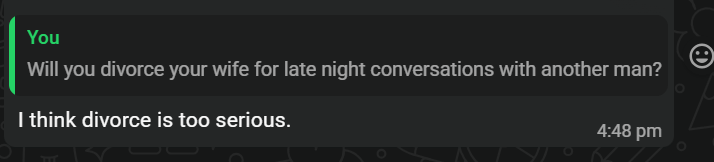
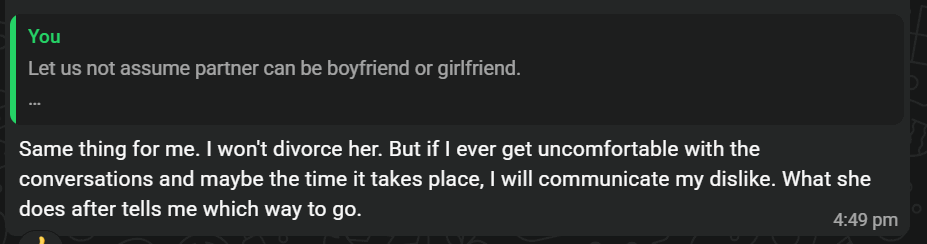
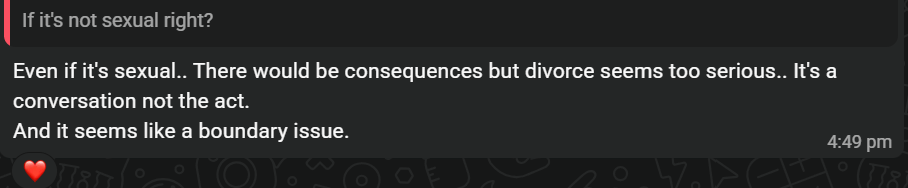
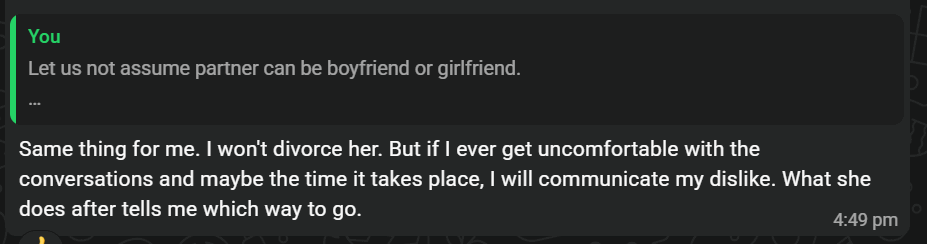
And surprisingly, as you can see, the responses are considerably fair. Most would get upset, but they did not reference breaking up, they did not say it exhibited a lack of love or a break of trust even, and even if they think it did, almost all were willing to talk about it with their partners and move on from it.
But these are all forms of cheating, in fact, even more dangerous forms of cheating.
I mean, think about it, it is easy to have sex with a person without feeling anything for them. The mere existence of prostitution and one night stands as social culture proves this.
But it is very rare to have these deep emotional conversations without feeling love or attachment for the other person.
So why are people willing to forgive the more dangerous crime and lose their minds over the logically lesser one?
Your partner can spend hours having conversations with someone else that they don’t have with you. They can feel understood by that person in ways you don’t understand them. They can share vulnerability, inside jokes, emotional intimacy that rivals or exceeds what exists between the two of you. And most people are still willing to at least have conversations about it and move on.
But the moment a body is involved, everything burns.
And this is where I am stumped, why is it easy to move past your partner literally cheating in the most dangerous way, but you cannot wrap your head around them being physical with someone else?
How did we even get to a point where we collectively agreed as a society that sex is the ultimate form of cheating? why do people think of cheating and think of sex?
And this really just shows me that at the core of it, it is not about him or her falling in love with someone else or out of love with you, it is something more primal, and I think that thing is exclusivity.
The body as territory.
We dress it up in the language of trust and betrayal because that sounds more dignified than what it actually is: a territorial response to the idea that someone else was where you were supposed to be. That someone else used what was yours. And this has absolutely nothing to do with love or the lack of it.
To prove it, I even went on to ask people again, would you marry a woman who has a high body count, and the reaction was identical to physical cheating. The same visceral rejection. The same language. The same unwillingness to move past the image.
Go to Twitter. Find the conversations about body count. Why would you marry someone who has slept with that many people? She is not wife material. I could never.
There is no relationship there. There is no agreement. There is no betrayal. The woman made her own choices with her own body before this man ever existed in her life. And yet.
Well, of course, I don’t need to state that this section of the argument is purely deductive. feel free to share your thoughts about it.
And please, I know this is a big ask, but just in case. If you ever cheated on your partner, kindly drop a comment and prove that you loved them even though you hurt them. What are friends for?
I have always thought cheating shouldn't be limited to just sex, as there are several other actions that can be considered cheating, too. Reading this just gave my thoughts a good backing.
This was a great read. beautifully written.
A beautiful read